Montessori language work starts by refining the child’s auditory and visual senses, preparing them for the mechanics of reading and writing. Key activities include:
- Oral Language Activities: These build a rich vocabulary and sound awareness. Examples are “I Spy” (focusing on initial sounds, e.g., “I spy with my little eye something that starts with the /b/ sound”), Three-Period Vocabulary Lessons (introducing new words by naming, associating, and recalling), and listening games. This mastery of sound is the bedrock of phonemic awareness.
- Preparation for Writing (Sensorial/Motor Skills): Activities like using the Metal Insets (a set of geometric frames and insets for tracing and coloring) refine fine motor skills, pencil grip, and control necessary for writing. Other Practical Life activities like pouring, spooning, and using clothes pins also strengthen hand dexterity.
- The Bridge to Reading and Writing (Phonics): This is where the practical materials truly shine:
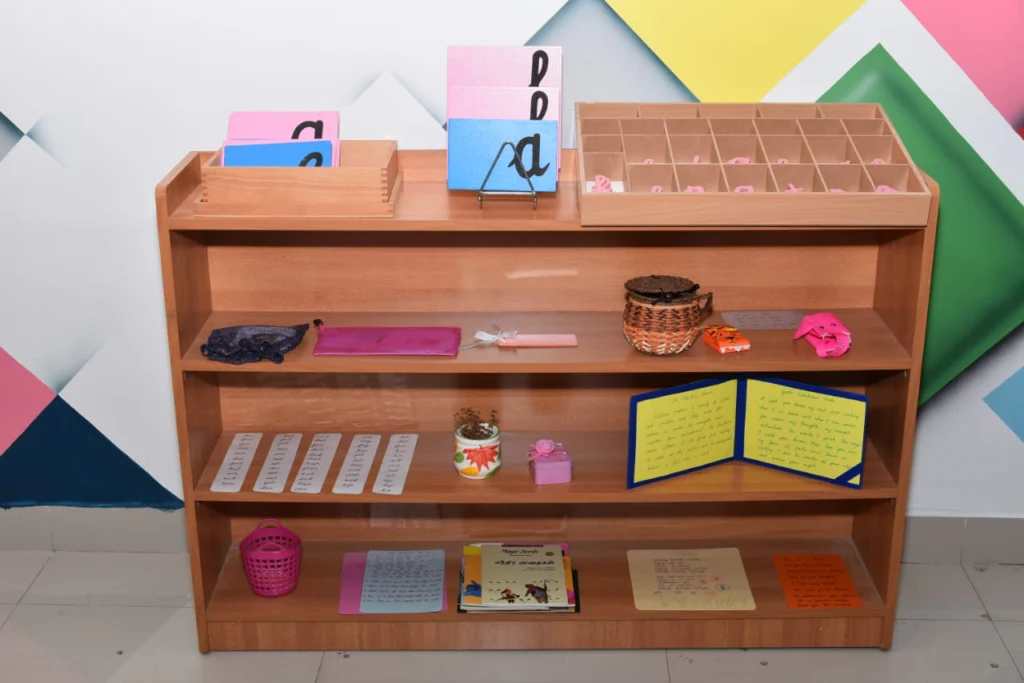
* Sandpaper Letters: Children trace the letters with their fingers while simultaneously hearing the phonetic sound (not the letter name). This engages the tactile, visual, and auditory senses, helping the child form a muscular memory of the letter’s shape.
* Movable Alphabet: Once the child knows several phonetic sounds, they use a box of individual letters to “write” words and sentences by laying them out on a mat. This allows the child to express their thoughts in writing before their hand is physically ready for sustained handwriting—leading to an “explosion into writing.” The Culture Area is a comprehensive, integrated study encompassing several subjects, all taught using specialized, concrete materials. Practical training involves:
- Geography
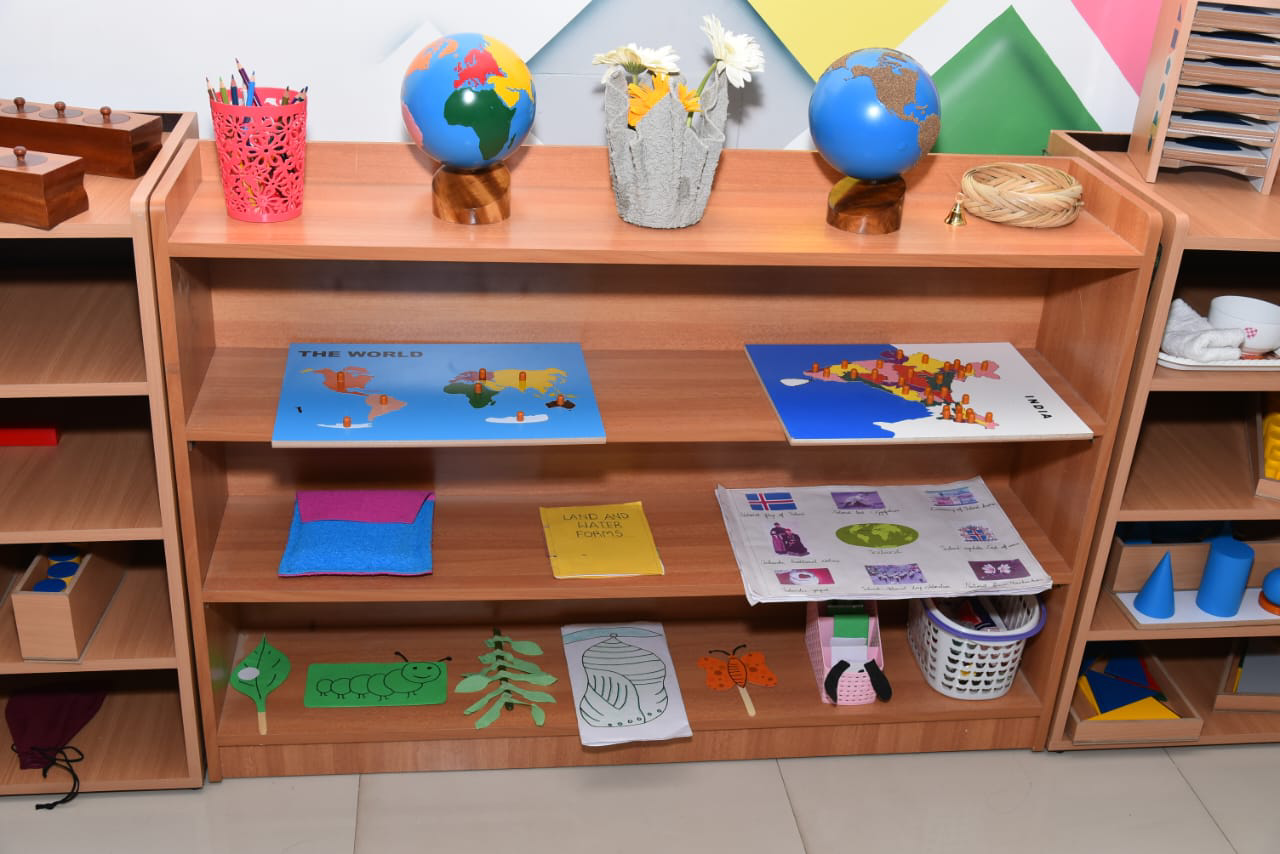
- Physical Geography: Learning to present materials like the Globe of Land and Water and Land and Water Forms (e.g., island, lake) to introduce basic physical concepts.
- Political Geography: Mastering the presentation of Puzzle Maps (continents and countries), the Continent Globe, and Continent Boxes (containing cultural artifacts/pictures) to teach the names and locations of continents and nations.
- Botany & Zoology
- Classification: Trainees practice presenting the Botany Cabinet and Zoology Cabinet (wooden puzzles and nomenclature cards for parts of plants and animals) to introduce scientific classification and vocabulary.
- Ecology/Care: Practical activities include hands-on plant care (watering, dusting leaves) and animal care (if class pets are present) to instill responsibility and an appreciation for living things.
- History
- Time and Cycles: Learning to use the Birthday Walk (celebrating the child’s revolution around the sun) and simple timelines to introduce the concept of the passage of time.
- Science
- Simple Experiments: Practicing demonstrations of basic physical science concepts, such as sink/float, magnetic/non-magnetic, and color mixing.
- Art and Music
- Creative Expression: Setting up and guiding children with various art media (painting, drawing, collage) and presenting the Montessori Bells for a concrete introduction to musical pitch and scale.
👩🏫 Practical Requirements for Trainees
During training, an adult learner must achieve mastery in several practical areas: - Material Presentations: Fluently and precisely demonstrate all core cultural materials using the three-period lesson structure, focusing on control of error and maximum child independence.
- Prepared Environment: Understand how to organize and maintain the cultural shelves for maximum visual appeal, order, and accessibility to the child.
- Observation and Follow-up: Develop skills in observing a child’s interaction with the cultural materials and planning appropriate extensions or further lessons based on their demonstrated interests and needs.
- Integration: Learn how to seamlessly link cultural concepts with other areas of the curriculum (e.g., using continent names in Language activities, or measuring ingredients from a specific culture’s food in Mathematics)
CONTACT
OMEGA EDUCATION & INSTITUTE
Union Bank Building, 24 Sengottiah Complex 1st floor Chithambaram Colony, 80 Feet Rd, Periyar Nagar,
Erode, Tamil Nadu 638001. Mobile: 73393 57576, 98430 57576, 73730 57576, Email: omegaeducationalit@gmail.com
Web: www.omega-education.com